anamorphic images with the Pinholekamera I
perspective extreme!
 view from the skylight. Through a pinhole in the lid of a tea box recorded Photo.
S chon from 16 Century painters dealt with this kind of perspective. The image / drawing showed only makes sense if you have a cylindrical mirror in the middle and put in this then the subject considered.
applications
An anamorphic lens is a lens, the anamorphic images produced: it is used as the "film" is a broad picture on a narrow format to compress, and then again in the projection on " be widescreen equalized "to.
pinhole means for Pinholefotografie this mean that the hole is placed in the lid of a cylinder. The light then falls on the inner surface of the cylinder shell and leads to extreme distortion of the subject.
exposure, processing
is not quite so easy to find the correct exposure. While at the top of the film / Photo paper, the distance is relatively small and requires only a short exposure time, one would need at the bottom of a multiple of this time for a proper exposure. If adopted seven ASA for the photographic paper resulting in sunshine an exposure difference of about 20 seconds to 10 minutes. So it is important to find a compromise and in the darkroom or the image processing on the computer hard nachzuhelfen to achieve a reasonably usable result.
can be helpful in this process, or technology, under the name DRI (Dynamic Range Increase), or operate HDR (High Dynamic Range). For the above photo I took while scanning once "exposed" to the depths and once on the lights and then with the software Photomatix Basic (available in this limited freeware version) and copied it. can also be similar with Photoshop Results.
Unfortunately, it is with my camera dose not possible to produce different exposures on film and then to work with the already mentioned methods.
paper size 13 x 18 cm
clearance hole / Photo paper about 35 mm - 120 mm
hole diameter 0.3 mm
cover approximately 116-400

In the tea box I have long pieces of cardboard glued to a sheet of 13 x 18 cm photo paper exactly edge to edge fit .
Show my cameras V
format -
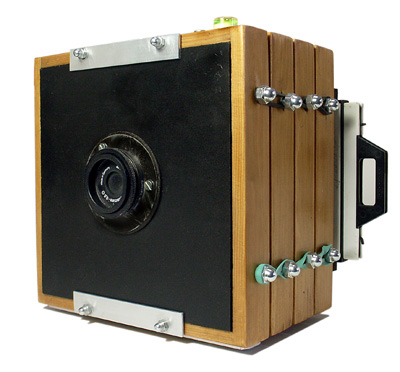
frame module camera in the 4 x 5 inch large format
nspiriert
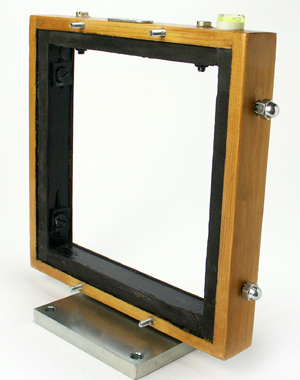
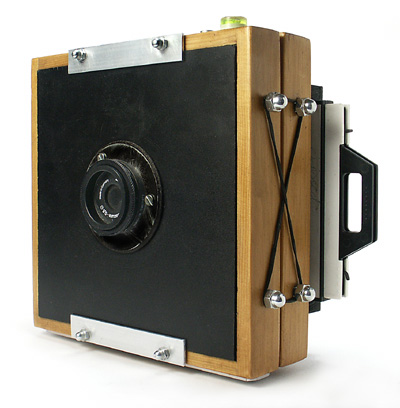
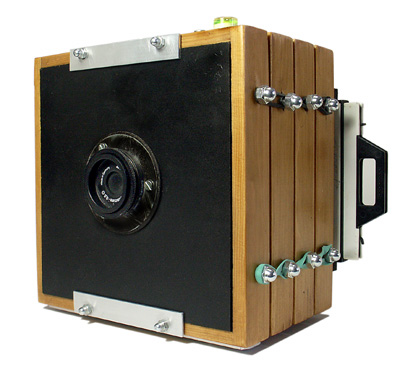
I by the multi-format camera by Zero Image, I have my own little by little "system camera" was developed and constructed with an open end. The principle is simple: because you do not focus a pinhole camera by means of a bellows must be extended to extract reciprocally uses pluggable framework, which are held together with rubber bands. On the first frame at the bottom of an aluminum flash bracket is attached with a tripod thread. The "lens board" is 3 mm thick made of black polyester. Then I placed the worn centered round an enlarger board with 42 mm thread, it can take either the lens Obscura-set or the T2-adapter. The two aluminum rails for fixing the plastic plate from the wood of the frame glued 4 mm machine screws, which I had sawed off the heads kept. The rubber bands I've hung in 6 mm screws that are inserted from the inside. The mother is the head of a round Conclusion. For easy alignment, I glued up a level (spirit level) on the frame.

on the inner, black-painted frame, I have front and rear glued foam rubber strips to improve the light leakage. It would be possible as well be black felt. The dimensions of the frame are suitable for sheet film cassettes or constructs the Polaroid pack film cassette. I have taken as an inner diameter of the outer frame 170 mm x 170 mm. The "lens board" has therefore the same size, everything else follows from the use of wood. A module is 30 mm deep, thus resulting "focal length" of 60 -, 90 - and 120 mm. These range from completely normally. The more context, more unstable and heavy and therefore difficult to handle the construction.
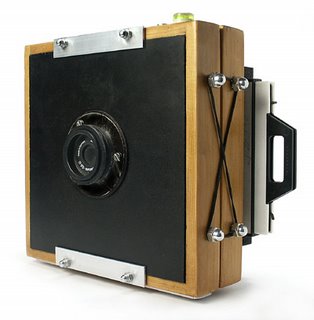
replaced with 2 frame is a wide-angle camera with an angle of about 108 degrees relative to the 4 x 5 inch film format.

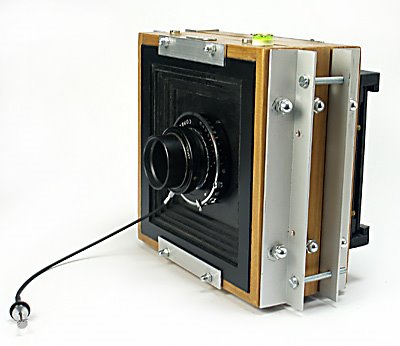
is properly stable, this design by using aluminum L-profiles, which are fixed with machine thread screws. Here is the version with 3 frame (90 mm) and Copalverschluß zone plate combination. To compensate for the larger clearance hole / film, caused by the closure, I have the "lens board" built back inside.

A 70 mm deep extension is used for inserts. In the above example is one half of (Papp) cylinder in a sheet of 13 x 18 cm photo paper or film fits. So it is practically the "doses camera" inside my "system"
 view from the skylight. Through a pinhole in the lid of a tea box recorded Photo.